Why this list exists
An equipment list has no value in itself. What matters is what each item makes possible and which problems it prevents on the day of the shoot. So here is the studio’s equipment, with the reason behind each element.
Picture: three angles, one consistent look
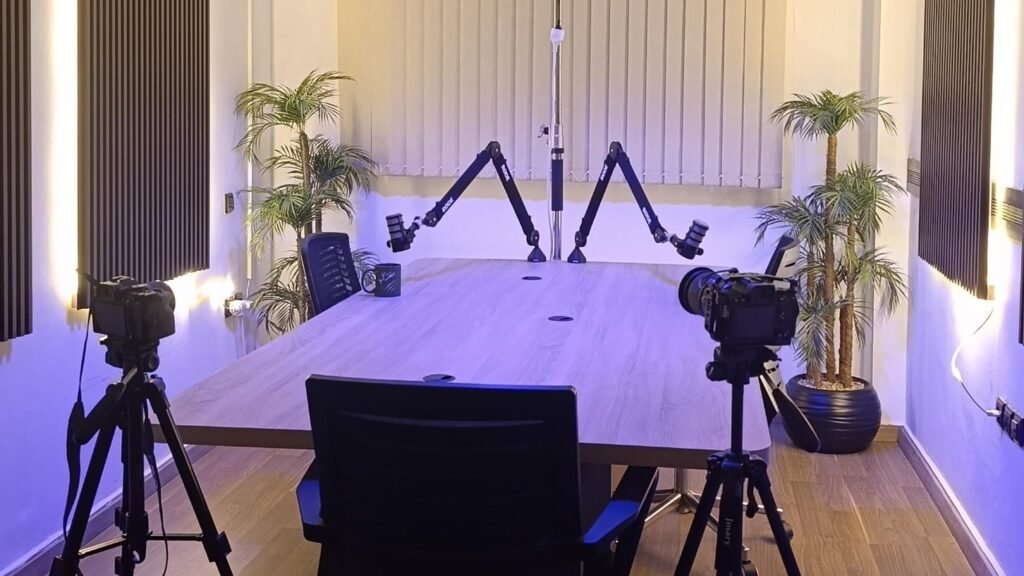
Two Sony A7 IV cameras hold the speaker angles. Their face tracking stays locked through an hour-long conversation, which avoids the shot drifting off in the middle of the best answer of the session. Details in our guide to the Sony A7 IV for video podcasting.
The invisible work is elsewhere: white balance set to the same value on all three bodies, exposure locked, same picture profile. That is what makes the cuts invisible in the edit. Two mismatched cameras show immediately, even to someone who could not explain why.
Sound: one track per speaker
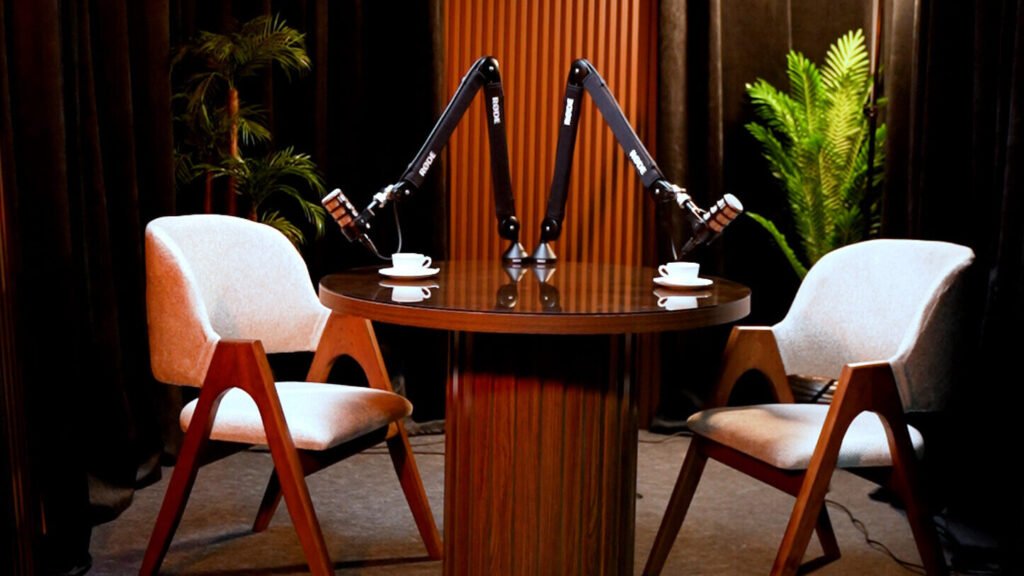
The RØDE PodMic microphones are dynamic microphones, meaning they pick up the voice up close and largely ignore the rest of the room. In a multi-person conversation, that is what keeps each mic from picking up the neighbor’s voice.
The RØDECaster Pro II handles inputs, levels and monitoring. In practice, each speaker has their level set separately and monitored during the recording. A loud guest and a quiet one do not produce an episode where the volume has to be turned up and down constantly.
This is the element that matters most. An audience leaves a video for bad sound long before it leaves for an average picture. See acoustics and voice in the studio and audio processing.
Control room: switching during the conversation
The ATEM Mini Pro ISO brings the video sources together into a single feed and lets us select shots live. That is what makes fast delivery after the shoot and live streaming to a platform possible. The sources are also recorded separately, which leaves the option of a traditional edit if the project calls for it. See the ATEM Mini Pro ISO control room.
Lighting: the most underrated element
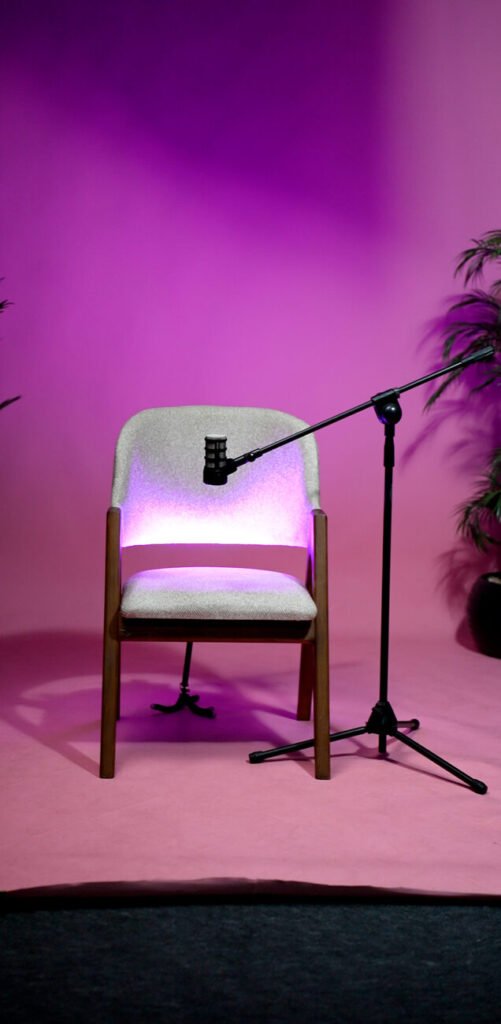
The LED lighting is set up and adjusted before you arrive, adapted to the faces and the chosen set. It is the element that makes the most visible difference between an amateur video and a professional one, more than the camera model. Poorly placed light hollows out faces, creates hard shadows and kills the depth of the set. See lighting for video podcasts.
The real order of priorities
| Rank | Element | Effect if it goes wrong |
|---|---|---|
| 1 | Sound | The audience leaves, whatever the quality of the content |
| 2 | Lighting | The picture looks amateur even with good cameras |
| 3 | Framing | The edit becomes monotonous or unusable |
| 4 | Camera body | Limited real effect if the first three are right |
That is why the most frequently asked question, which camera to choose, is also the least decisive. The full reasoning is in the video podcast equipment guide.
What you do not need to bring
Cameras, microphones, headphones, lighting, control room and set are on site and prepared before you arrive. You come with your notes, any visuals to include and your speakers. Setting up the set does not come out of your time slot.
This audio equipment is the same as in the recording studio in Rabat, for voice-over and audio podcasts.
See what a booking with this equipment includes: podcast studio rental in Rabat.
The minimum equipment to get started
For an audio pilot, a well-placed microphone, headphones, a reliable computer or recorder and a quiet room can be enough. The priority is an intelligible voice and a saved file. Add video only if it genuinely serves distribution or the brand.
Do you need to own all this equipment to launch a podcast?
No. To get started, editorial quality and consistency matter more than an equipment list. Buying a complete multi-camera chain also means cabling, mounts, storage, set-up time and production skills. Booking a studio can be simpler for one-off shoots or concentrated series.
When to move to a professional chain?
Several guests, several cameras and a regular publishing schedule require synchronization, monitoring, power and backups. The studio saves you from buying the whole chain before the format is proven. Compare this option in studio or home.
Equipment for a podcast with 2, 3 or 4 people
The number of people mainly changes the number of microphones, the layout and the framing. A two-person interview is relatively simple to cover. A panel discussion needs more anticipation for overlapping speakers. See the guides two-person podcast and three- or four-person podcast.
Equipment guides
Frequently asked questions
Can you bring your own microphone or camera?
It is possible in some cases, but it has to be announced in advance: integrating an outside source into the control room takes set-up time, and that time comes out of the filming slot.
Are the source files handed over?
Yes, depending on the package chosen. The Raw shoot includes the camera files and the separate audio tracks. See our Pricing.
How many microphones are available?
Up to four speakers, each with their own microphone and level. Beyond that, the constraint is how readable the set is on screen, not the number of inputs.
Next step
Set configurations are detailed under Studio, the packages under Pricing. To book a time slot, head to booking.